When you study software engineering, textbooks teach you a clean, predictable universe. They assume high-speed fiber, infinite cloud storage, users with Visa cards hooked to Apple Pay, and devices packing six gigabytes of RAM. They teach you to build for Silicon Valley, London, or Tokyo.
Then you release an app in Addis Ababa.
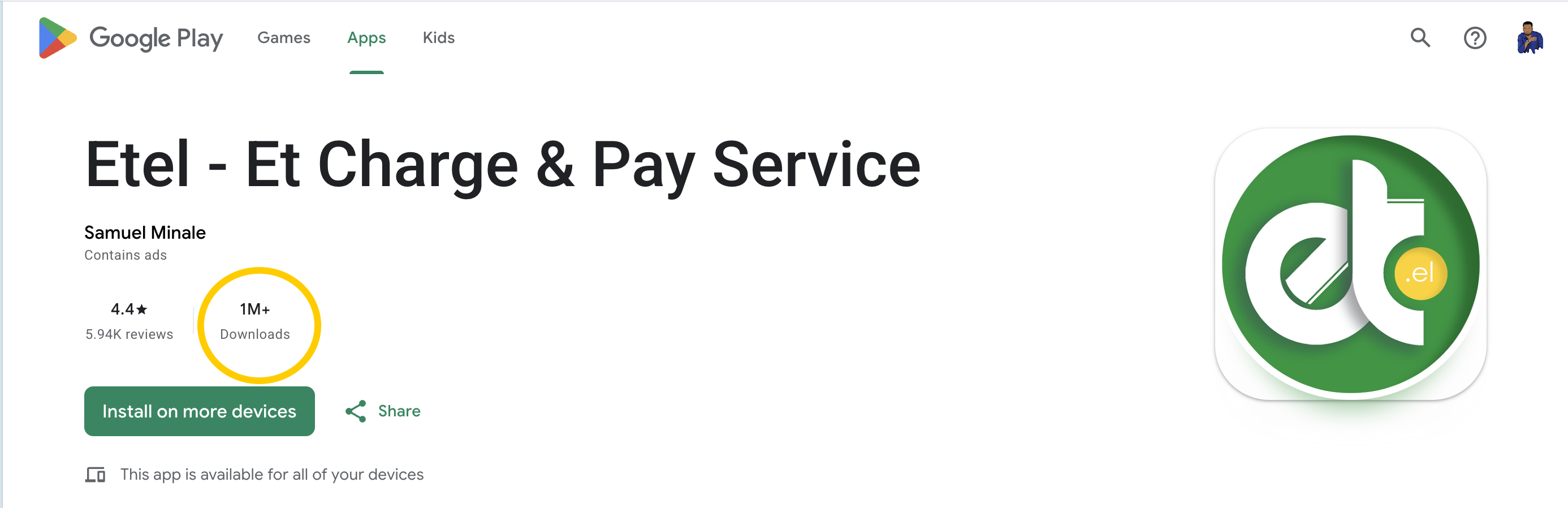
Over the last several years, apps I have designed and built have crossed one million lifetime downloads across Google Play, direct APK distribution, and the quiet underground networks of peer-to-peer sharing. Those one million installs didn't just teach me how to write better code; they demolished almost every comfortable assumption I held about how software gets consumed.
“The real test of an engineer is not how elegant your app looks on a gigabit Wi-Fi connection, but whether it opens and delivers value in three seconds on a two-gigabyte phone in Hawassa.”
1. The Myth of the Always-Connected User
Most modern software is built on an invisible foundation: the expectation that a server is always listening. If a user opens an app and sees a spinning progress wheel for eight seconds, the app has failed.
In Ethiopia, mobile data is an active economic decision. A user buys a daily or weekly data package, checks Telegram, scans their messages, and turns mobile data off immediately to conserve megabytes. If your application requires an active socket connection just to render its home screen, you will suffer a 70% uninstallation rate within 48 hours.
I had to rebuild my entire architecture around Offline-First, Cloud-Last:
The local SQLite or Hive database must be the absolute source of truth. Every piece of core content—whether books, media guides, or interactive tools—must work out of the box without pinging a server. The internet should only ever be used to enrich an already functioning experience, never to establish it.
2. The "Dark Funnel": Telegram, SHAREit, and Flash Drives
If your Google Play Console reports 10,000 active installs for the month, there is a very high probability that another 30,000 people are running your application without Google knowing anything about it.
Across East Africa, the primary app store is not always Google Play. It is peer-to-peer Bluetooth sharing tools like SHAREit and Xender, alongside public Telegram channels. Someone downloads your APK in a coffee shop with fast Wi-Fi, drops it into a university Telegram group, and within an hour, hundreds of students have installed it offline.
| The Global Assumption | The Local Reality |
|---|---|
| Users update apps automatically via Play Store. | Users run versions from two years ago via peer transfer. |
| Push notifications wake the phone reliably. | Aggressive OS battery killers terminate background services. |
| Monetize via in-app purchases ($0.99 minimum). | Forex card access is rare; local wallets rule. |
| Crash analytics stream instantly to Sentry or Firebase. | Crash logs sit silently until the next Wi-Fi connection. |
This reality fundamentally shifts how you manage versioning. You cannot rely on forced remote updates. You cannot assume your user is on the latest API schema. Every local database migration must be backwards compatible across years, not weeks.
3. The Tyranny of the Megabyte
In global markets, teams ship 120MB Flutter or React Native bundles without thinking twice. In Ethiopia, every additional five megabytes in your APK size is an active deterrent to download.
When users see an app on the store that weighs 80MB, they compare it to the cost of their data bundle. Is this app worth 30 Birr of bandwidth? If the answer isn't an enthusiastic yes, they skip it.
To get to a million users, I had to obsess over asset compression:
Converting audio to heavily optimized low-bitrate AAC or Opus, converting heavy PNG assets to optimized WebP, stripping unneeded architecture binaries with app bundles, and embedding vector icons instead of raster images. Keeping an app under 20MB is often the difference between virality and obscurity.
4. The Hardware Ceiling: 1GB RAM and Storage Limits
It is easy to develop on an M-series Mac with an emulator running silky smooth at 120Hz. But out in the field, your users are holding budget Android devices—Tecno, Infinix, Itel, and older Samsungs—often with 1GB to 2GB of total RAM, running custom Android forks with aggressive memory management.
If your app leaks memory or fails to dispose controllers, the Android system killer will close it the moment the user switches to take a call. Worse, if your app fills their internal storage with unmanaged caches, the user will get a system warning: "Storage Almost Full."
Guess which app they delete first? The one eating 400MB of uncleaned cache.
5. The Ge'ez Typography and Rendering Barrier
If you build for Ethiopia, you are building in Amharic, Afaan Oromoo, Tigrinya, and English. Supporting the Ge'ez script (Fidel) comes with unique design challenges that standard Western UI kits ignore.
Older Android system fonts frequently fail to render Ethiopic characters cleanly, resulting in "tofu" boxes or irregular line heights that break card layouts. Embedded Amharic fonts must be bundled carefully without bloating the binary, and line-heights require generous breathing room so diacritics and character vowel markers don't get clipped by the viewport.
“Localization is not translating strings in a JSON file. Localization is respecting the visual dignity of a script that has existed for thousands of years on a 5-inch glass screen.”
6. Monetization in a Closed Financial Ecosystem
The standard playbook—put an app on Google Play, add a $1.99 in-app purchase, and watch Stripe pay out—is completely broken for local users in developing economies.
Because international debit and credit cards are virtually nonexistent for everyday users due to strict foreign currency controls, Google Play Billing is essentially an invisible wall. You can have hundreds of thousands of active daily users who genuinely want to pay you, but who cannot execute a transaction through standard Western payment rails.
This forced me to explore hybrid strategies:
Combining localized advertising networks, exploring domestic mobile money integrations (like Telebirr and CBE Birr), and using the apps as digital anchors to distribute physical books, diaspora-facing services, and digital products to international supporters.
The Six Core Lessons
Build for the Subway, Not the Fiber Line
Assume zero connectivity on startup. Let the user access their data immediately, and sync quietly in the background when the world allows.
Respect the Device's Constraints
Clean your image caches aggressively. Release controllers. Treat every megabyte of storage as if you are renting it from the user.
Support Happens Where People Are
Nobody in Addis Ababa fills out a Zendesk ticket or sends an email. Users want to talk on Telegram. Being accessible builds trust that money cannot buy.
Backwards Compatibility Is Eternal
Because APKs circulate peer-to-peer without app store updates, your backend APIs must tolerate versions from years ago without throwing breaking errors.
Size Is Your First Marketing Hurdle
A 15MB app will get shared from phone to phone in seconds. A 90MB app requires deliberation and Wi-Fi. Keep the binary tight.
Building Locally Gives You Global Resilience
When you master building software that works flawlessly under constrained connectivity, low RAM, and erratic power, you can build software that excels anywhere in the world.
Building With Purpose from Addis Ababa
Reaching one million downloads across a country that is still coming online isn't just a metric on a console. It is a reminder that people are hungry for tools, literature, and software that honor their culture, their language, and their daily technical constraints.
Silicon Valley sets the standards for development frameworks, but the emerging world tests their true resilience.
Don't wait for perfect infrastructure.
Build for the world that exists right in front of you.